Support
Manual
Brochure
FAQ for RP Kit
What's the difference between difference versions of WSSV RP Kits?
Our WSSV RP Rapid Test Kits available in two versions. V1 is in cassette, while V2 is in test strip. Both have the same detection technology and performance, but the operation method is slightly different due to different forms. For discrepancies, you can refer to the operational manual on our website.
V1 has been registered in WOAH as a certified diagnostic kit for WSSV, and V2 is under the process of applying for changes as well. V1 is only available in 20 sets of strips(P11-0101-20), while V2 is available in 5 sets of strips(P11-0102-05) and 20 sets of strips(P11-0102-20).
However, there are two important considerations to keep in mind:
- The sensitivity of our immunological rapid test kit is not as high as QPCR nucleic acid detection.
- Feed ingredients may contain inhibitors that could affect the result, which may require further testing to confirm accuracy.
Is WSSV RP Rapid Test Kit applicable for samples of fishmeal and shrimp feed (dry feed like a powder or small pellets)?
Our current target for the rapid test kit is shrimp tissues, and we have not conducted tests for fishmeal or feed at this time.
We have received inquiries from customers regarding the possibility of viral contamination in fishmeal used in feed.
We understand that during the high-temperature processing of the feed, viruses typically become inactive and lose their infectivity. However, the high sensitivity of nucleic acid tests may sometimes lead to false-positive results due to the presence of residual viral nucleic acid fragments, which can be a challenge.
The rapid test kit we offer is designed to detect viral proteins, which are more susceptible to degradation during the manufacturing process.
This implies that the kit may indicate the presence of actively infective viruses.
However, there are two important considerations to keep in mind:
- The sensitivity of our immunological rapid test kit is not as high as QPCR nucleic acid detection.
- Feed ingredients may contain inhibitors that could affect the result, which may require further testing to confirm accuracy
FAQ for QD Kit
How to select the extraction kit for QD products?
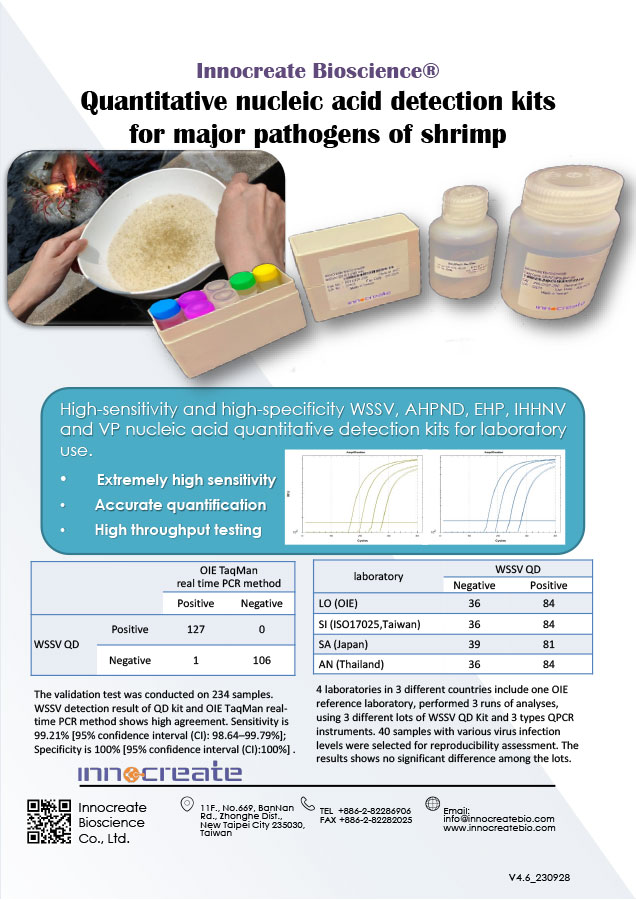
We offer both the Easy Lysis extraction kit and the CTAB/DTAB extraction kit for our QPCR test kit products. The Easy Lysis kit is designed for pleopod DNA extraction, while the CTAB/DTAB kit serves the purpose of DNA extraction, especially for challenging samples like hepatopancreas. But some of our customers still request the Easy Lysis kit because it is easier to use and saves time.
All of our QD kits include an internal control shrimp target that monitors inhibition in each reaction. However, for intricate samples like EHP spores, the Easy Lysis kit’s lysis efficiency isn’t as robust as the CTAB/DTAB tests. The choice depends on the customer’s sensitivity requirements, as the difference is subtle based on their specific samples and needs.
How we positioning the VP QD Kit and AHPND QD Kit?
The AHPND kit target is the toxin gene pirA/B, not VP (Vibrio parahaemolyticus), and the target of the VP kit is a specific target gene of Vibrio parahaemolyticus. The toxin plasmid (containing the toxin gene) could be found in Vibrio parahaemolyticus and many other strains of Vibrio. So direct detecting the toxin gene is the better way.
The request was made for the VP kit of some customers; they maybe want to align it with the results of the TCBS plate because it can specifically identify Vibrio parahaemolyticus.
FAQ for Inno A1
How does WSSV protection work?
It has to be tested with the feed production process.
Is Inno A1 for WSSV cures?
It’s for prevention, blocks the infection chain, but could not cure infected shrimps. (Almost no drug can cure virus disease, for example, COVID-19)
Technical information : Shrimp Diseases
Shrimp White Spot Syndrome
White spots appear on the carapace.
WSSV
In the process of spawning, the infected progeny is infected by the method of egg attachment.
Acute hepatopancreatic necrosis disease
Acute hepatopancreatic necrosis disease (AHPND), also called early mortality syndrome (EMS), is a recently emergent shrimp bacterial disease that has resulted in substantial economic losses since 2009.
AHPND
AHPND is caused by toxic strains of Vibrio parahaemolyticus that have acquired a “selfish plasmid” encoding the deadly binary toxins PirAvp/PirBvp.
Enterocytozoon hepatopenaei
Microsporidian parasite.
EHP
EHP colonize the shrimp gastrointestinal tract and produce a toxin that causes tissue destruction and dysfunction of the shrimp digestive organ (hepatopancrease).
Shrimp Hemocyte Iridescent Virus
A new iridescent virus that causes severe disease in farmed in Zhejiang, China, has been verified as specified as shrimp hemocyte iridescent virus..
SHIV
The symptoms of SHIV infection “include slight loss of color on the surface and cut of hepatopancreas, empty stomach and guts, soft shell in partially infected shrimp and slightly reddish body in one-third of individuals”.
Get in Touch
If you have any questions, please contact us and we will respond to you as soon as possible.